
Recyclable masonry walls for the building sector
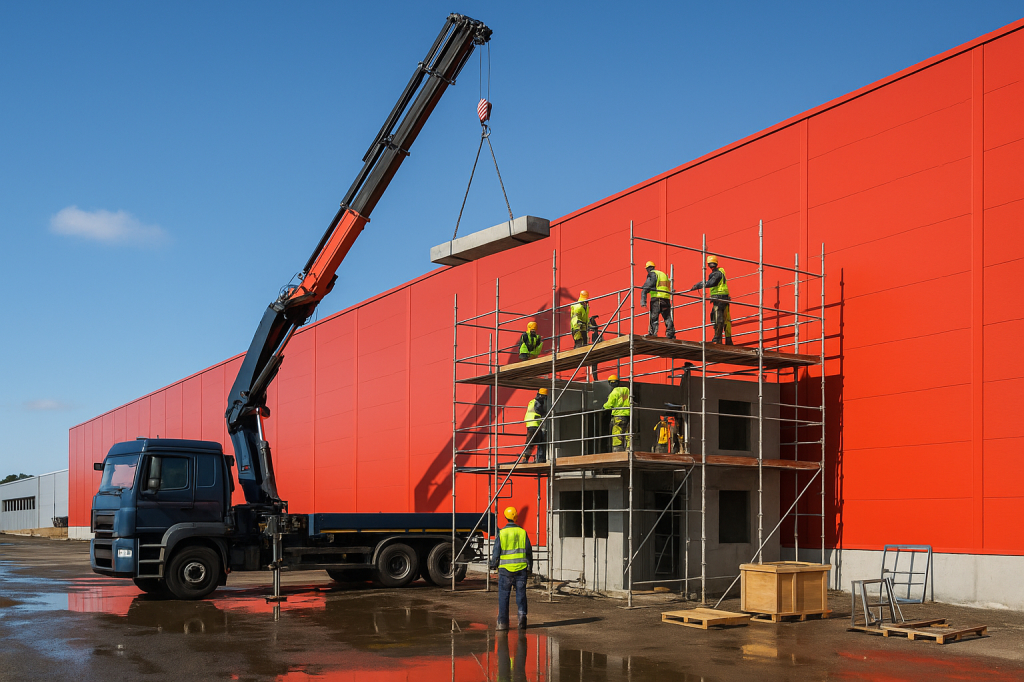
image:
The brick wall sections can be carefully taken apart and rebuilt without sustaining damage. The photo shows the structure being reassembled after dismantling.
Credit: TU Graz
The construction industry still faces major challenges in cutting down resource consumption and greenhouse gas emissions. A significant issue lies in the large volume of waste generated when buildings are demolished. This is particularly problematic for structures designed for relatively short service lives—such as retail markets used for only ten to 20 years—which negatively affect environmental performance. Through the Re-Use Ziegelwand project, researchers at Graz University of Technology (TU Graz), working in partnership with Austria’s largest brick manufacturer wienerberger, have developed a system that separates the lifespan of building materials from that of the building itself. At the core of the concept are industrially prefabricated brick wall modules assembled without traditional mortar joints, instead using reversible connection methods. As a result, the walls can be dismantled and reused multiple times after a building is taken down.
60 per cent CO2 savings over three life cycles
“Bricks are premium construction materials, but their production requires substantial resources,” explains project manager Hans Hafellner from the Institute of Building Physics, Services and Construction at TU Graz. “Being able to remove them intact after a building’s use phase and reinstall them elsewhere offers tremendous ecological benefits.” According to the team’s findings, the innovative jointing system enables a considerable reduction in emissions during subsequent use phases. When three full life cycles are considered, CO₂ emissions can be lowered by approximately 60 percent compared to conventional masonry construction.
One of the main technical challenges was ensuring that the reusable walls could be dismantled while still meeting strict structural standards, including tolerances, load-bearing capacity, airtightness, thermal insulation and overall stability. In addition to the reversible jointing system, several complementary design measures were implemented. The walls are 44 centimeters thick, and the bricks are filled with insulating wool to achieve the required thermal performance. The prefabricated wall elements are also plastered in the factory, minimizing on-site labor. Structural stability can be achieved in two ways: either through a sufficiently heavy roof structure that secures the building, or by using vertically inserted, pre-stressed threaded rods that run through the brick units to reinforce the walls.
Successful dismantling and reconstruction
The research team validated the concept by constructing a full-scale demonstrator building. The joint systems and wall assemblies met all structural and performance requirements, and the building remained fully functional even after being dismantled and reconstructed at a new location. To ensure that this reliability extends to buildings after ten to 20 years of use, the researchers employ modal analysis. This method involves stimulating the prefabricated brick walls with vibrations to determine their natural frequency in an undamaged state. Any variation in natural frequency over time can indicate changes in load-bearing performance, allowing structural integrity to be assessed without destructive testing.
“The successful large-scale construction, dismantling and reassembly of the demonstrator proves that the system is technically viable and robust under realistic conditions,” says Andreas Trummer from the Institute of Structural Design at TU Graz, who oversaw the project. “In the long term, this approach benefits not only building owners—since the structure retains a higher residual value at the end of its service life—but also the environment.” The research involved collaboration between the Institute of Building Physics, Services and Construction, the Institute of Structural Design, the Laboratory for Structural Engineering at TU Graz, and wienerberger.
Method of Research
Experimental study
Subject of Research
Not applicable
Article Title
A Reusable Prefabricated Brick Wall System for Circular Construction: Development, Structural Concept, and Life Cycle Potential
Article Publication Date
12-Aug-2026