Small new dinosaur Foskeia pelendonum redefines the dinosaur lineage
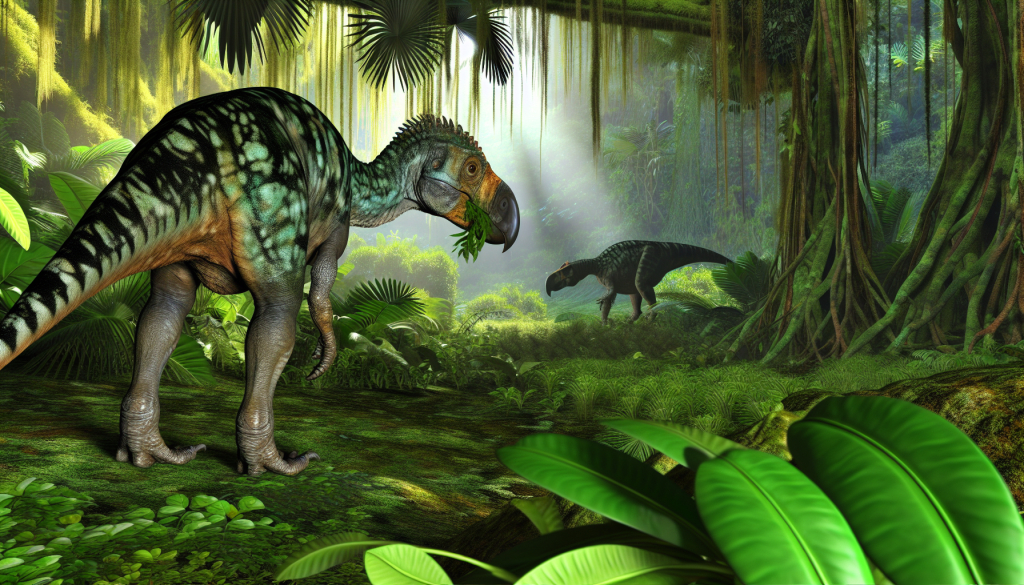
Image:
Artistic reconstruction of Foskeia pelendonum
Illustration by Martina Charnell
Fossils belonging to at least five individuals were discovered by Fidel Torcida Fernández-Baldor from the Dinosaur Museum in Salas de los Infantes. “From the outset, we realized these remains were unusual because of how tiny they were. What’s more, studying this species has changed our broad understanding of ornithopod dinosaur evolution,” he remarked.
The new dinosaur was named Foskeia, a term inspired by ancient Greek. The prefix “fos” means “light”, referencing the small size and delicate build of the adult specimens (Dieudonné et al. 2023). The segment “skei” comes from “boskein”, meaning “to forage”. Its species name, pelendonum, pays homage to the Pelendones, an ancient Celtiberian people from the Duero River vicinity, in areas spanning northern Soria, southeastern Burgos, and possibly parts of La Rioja.
The paleontologists point out the evolutionary importance of Foskeia. Marcos Becerra (Universidad Nacional de Córdoba) shared: “Its small size doesn’t make it simple — the skull is highly specialized and unique.” Thierry Tortosa (Sainte Victoire Natural Reserve) observed: “Foskeia fills in a 70-million-year gap, providing crucial insight into a forgotten chapter in dinosaur evolution.” Tábata Zanesco Ferreira (Universidade Federal do Rio de Janeiro) commented: “It’s not just a scaled-down Iguanodon — it represents a completely new form.” Penélope Cruzado-Caballero (Universidad de La Laguna) added: “Its peculiar traits force us to rethink dinosaur lineages.”
Bone analysis led by Dr. Koen Stein (Vrije Universiteit Brussel) verified that the largest of the fossils came from an adult. “The bone tissue shows that at least one individual had reached maturity, with signs of a metabolic rate similar to what you’d find in small mammals or birds. Understanding how these animals developed over time is crucial when comparing them with other species, especially since young dinosaurs can change significantly as they grow,” Stein explained.
A fresh evolutionary study identifies Foskeia as closely related to the Australian Muttaburrasaurus, placing both within the Rhabdodontomorpha group and expanding the Rhabdodontia lineage in Europe. Notably, the findings also support a rekindled theory known as Phytodinosauria. “Our data suggest that plant-eating dinosaurs formed a single, natural group,” said Dieudonné. “But this idea needs further testing through future research.”
Although small in size, Foskeia had distinct teeth and showed signs of changing posture during its life, likely depending on quick movements to navigate thick forests. Dieudonné explained: “These bones show that even at small sizes, evolution generated bold and unique adaptations. Understanding the less showy species — the fragments and the small — will be key to the future of dinosaur paleontology.”
Reference:
Dieudonné, P.E., Zanesco, T., Becerra, M.G., Tortosa, T., Cruzado-Caballero, P., Stein, K., Torcida Fernández-Baldor, F. (2026). The Vegagete rhabdodontomorph Foskeia pelendonum gen. et sp. nov. from the Upper-Barremian – Lower Aptian of Salas de los Infantes (Burgos Province, Spain) and a new phylogeny of ornithischian dinosaurs. Papers in Palaeontology.
Journal
Papers in Palaeontology
DOI
10.1002/spp2.70057