Chemical contaminants turn carbon surfaces ultra-slippery
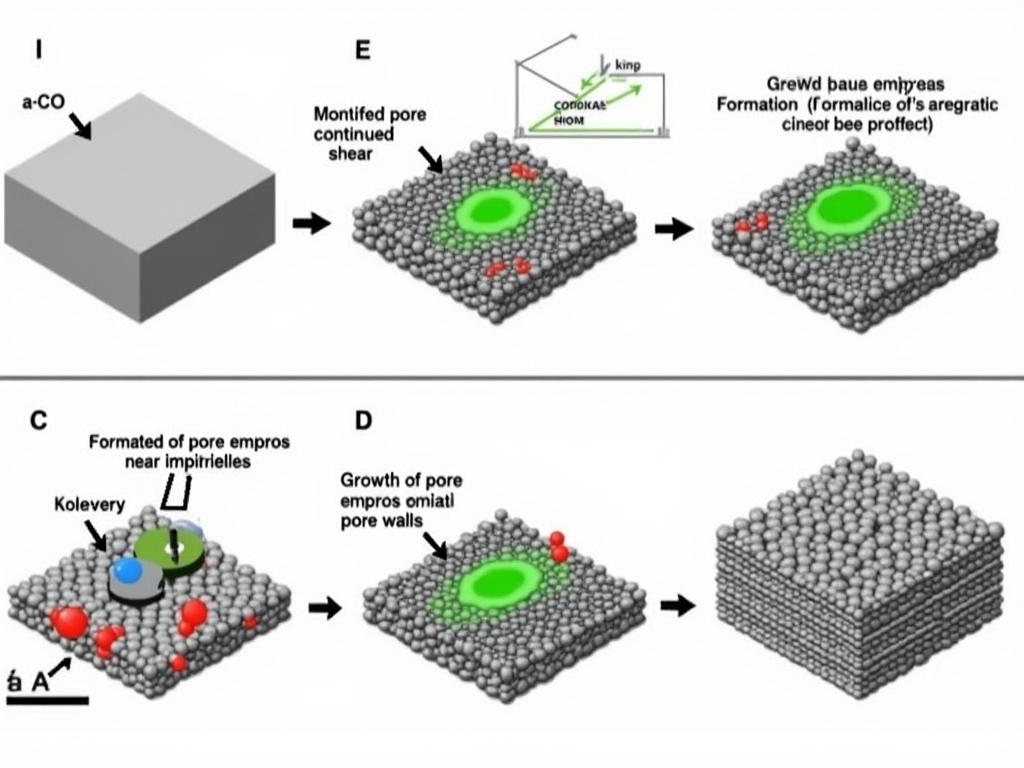
When materials are subjected to sliding forces, small amounts of impurities such as oxygen can actually help stabilize nano-sized voids in amorphous carbon (a-C). This stabilization allows nearby carbon atoms to rearrange into aromatic, graphene-like configurations that promote extremely low friction.
Credit: Osaka Metropolitan University
Impurities are typically viewed as flaws that should be eliminated to enhance material performance. However, new findings from Osaka Metropolitan University and the Fraunhofer Institute for Mechanics of Materials IWM indicate that, under certain conditions, a controlled presence of chemical impurities can improve how smoothly materials slide against each other.
Friction arises whenever two surfaces move in contact. Although friction is vital for many technologies, it also leads to mechanical wear, energy loss, and reduced durability of components. For this reason, scientists have long pursued superlow friction, or superlubricity, where surfaces glide past one another with minimal resistance.
“Graphene- and graphite-like structures are known for enabling near-frictionless motion, but reliably forming and preserving these structures in real-world systems has been difficult,” explained Takuya Kuwahara, lecturer at Osaka Metropolitan University’s Graduate School of Engineering and lead author of the research.
Carbon exists in several structural forms, including graphene, graphite, diamond, and amorphous carbon. Each form behaves differently when subjected to sliding forces.
Graphite consists of stacked graphene layers that can easily shift over one another, producing very low friction. Graphene itself is made of single-atom-thick sheets of carbon. Diamond, by contrast, forms a rigid three-dimensional lattice that is extremely hard and resistant to sliding. Amorphous carbon, meanwhile, lacks a well-ordered atomic structure.
Amorphous carbon drew the researchers’ attention because it can transform into graphitic, aromatic configurations at the contact points between sliding surfaces.
This transformation, known as shear-induced aromatization, suggests the possibility of coatings that can create—and potentially regenerate—their own low-friction interfaces during operation.
However, a key question remained: Why does this structural change occur in some situations but not in others?
To answer this, the team carried out an extensive computational investigation using quantum-mechanical molecular dynamics simulations. Their analysis revealed that chemical impurities play a decisive role.
“Impurities are often associated with weakened performance, but our results show that certain chemical impurities are essential for forming superlow-friction interfaces in amorphous carbon,” Kuwahara noted.
Across 1,000 simulations of sheared amorphous carbon containing various impurity elements, the researchers observed a clear trend. Impurities with low valency—those forming fewer than four chemical bonds—consistently encouraged the development of graphitic, aromatic structures. Hydrogen and oxygen were especially effective in enabling stable low-friction interfaces. In contrast, pure carbon and silicon-doped systems did not produce the same structural evolution.
The simulations indicated that these low-valency impurities help stabilize tiny voids within the carbon matrix. Under ongoing mechanical stress, carbon atoms surrounding these voids reorganize into aromatic ring structures similar to graphene or graphite. At the same time, the impurities inhibit the reformation of harder, diamond-like configurations, allowing the slippery interface to remain stable.
These findings challenge the traditional assumption that impurities primarily degrade materials. Instead, they point to a new strategy for materials design: deliberately adjusting the type and concentration of impurities to guide how carbon coatings restructure under mechanical stress. Rather than depending solely on external lubricants or pre-fabricated graphitic layers, future materials could dynamically generate low-friction surfaces during use.
The team plans to further investigate this mechanism under more realistic conditions, including systems with multiple impurity types and varying environmental factors such as temperature and pressure. Experimental confirmation of the predicted atomic-scale processes will also be an important next step.
“Our long-term aim is to develop design principles for carbon-based materials that can create and sustain ultralow-friction interfaces in practical applications,” Kuwahara said. “Such advancements could minimize wear, enhance durability, and reduce energy losses in a wide array of mechanical systems.”
The study was published in Advanced Science.
###
About OMU
Osaka Metropolitan University, one of Japan’s largest public universities, is dedicated to advancing society through the “Convergence of Knowledge” and the pursuit of globally competitive research excellence.
Journal
Advanced Science
DOI
10.1002/advs.75566
Method of Research
Computational simulation/modeling
Subject of Research
Not applicable
Article Title
Shear-Induced Emergence of Aromatic Superlow-Friction Interfaces in Amorphous Carbon: Triggering Chemical Impurities and Atomic-Scale Mechanisms
Article Publication Date
25-May-2026
COI Statement
The authors declare no conflicts of interest.