Scientists stunned by massive bubble from supergiant star
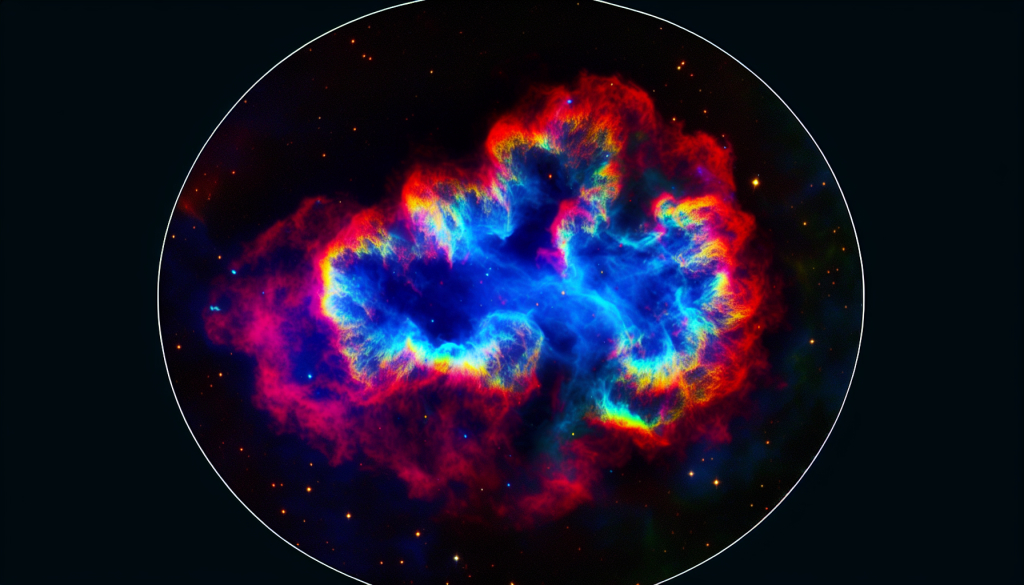
Image:
Red supergiant DFK 52 and its surrounding region captured by ALMA. The immense bubble of gas and dust created by this star stretches roughly 1.4 light years across—thousands of times larger than the Solar System. ALMA detects millimetre-wavelength light, invisible to the human eye, emitted by elements such as carbon monoxide and silicon monoxide. By using the Doppler effect, scientists determined how quickly the gas is moving in relation to the star. In the image, red areas represent material receding from us, and blue shows gas moving toward us.
Credit: ALMA (ESO/NAOJ/NRAO)/M. Siebert et al
A team of astronomers from Chalmers University of Technology in Sweden has identified a giant, expanding gas and dust bubble around a red supergiant star— the largest structure of its type ever seen in our galaxy. This cloud, equal in mass to our Sun, seems to have formed during a dramatic outburst about 4,000 years ago. It's still unknown how the star endured such a powerful release.
Their work has been released in the journal Astronomy and Astrophysics, led by Mark Siebert from Chalmers. The team used the ALMA radio telescope in Chile to examine the red supergiant DFK 52, a star similar in nature to Betelgeuse.
“We were amazed by ALMA’s view,” noted Mark Siebert. “Although DFK 52 closely resembles Betelgeuse, it's surrounded by an enormous and turbulent envelope of gas and dust.”
The bubble, made up of gas and dust that previously belonged to the star, has spread out to 1.4 light years in diameter. That’s thousands of times larger than the orbit of Neptune—the edge of our Solar System.
If DFK 52 were as near as Betelgeuse, we would see this bubble cover about one-third of the Moon’s width in the night sky.
Radio data from ALMA enabled astronomers to monitor how the molecules in the bubble are moving. Their analysis showed the bubble is expanding, likely a result of the star suddenly ejecting its external layers during a powerful event several millennia ago.
“This material was once inside the star,” said Elvire De Beck from Chalmers. “It appears there was an explosion around four thousand years ago that blew it out. In cosmic timelines, that’s remarkably recent.”
The Next Supernova in Our Galaxy?
What caused DFK 52 to lose so much of its mass without undergoing a full supernova remains unclear. One theory is that the star may have an undetected companion, which could have influenced the eruption.
“We don’t yet understand how the star could shed so much of itself so rapidly,” says Siebert. “It’s possible that a hidden partner star helped with the ejection—something we’ve also considered for Betelgeuse.”
Red supergiants like DFK 52 are nearing their life’s end and are expected to eventually explode. Could this star be destined for a dramatic finale?
“Further studies are being planned to track what’s unfolding,” De Beck adds. “There’s a chance this could be the next supernova to occur in our galaxy. If DFK 52 is a typical red supergiant, that explosion might happen within the next million years.”
Research Highlights:
These findings were published in the paper titled "Stephenson 2 DFK 52: Discovery of an exotic red supergiant in the massive stellar cluster RSGC2" in Astronomy and Astrophysics. The star’s image was also featured by ESO as their Picture of the Week.
The research group included Mark Siebert, Elvire De Beck, and Wouter Vlemmings from Chalmers, along with Guillermo Quintana Lacaci from the Instituto de Fisica Fundamental in Spain.
Red supergiants are among the rarest and brightest types of stars. These enormous stars have a mass over eight times that of the Sun and are in their final evolutionary stage. Their intense energy and mass ejections contribute to the creation of heavier elements, enriching the galaxy and triggering new star birth.
In the Milky Way, some of the nearest red supergiants are clearly visible with the naked eye in dark skies. Well-known examples include Betelgeuse in Orion and Antares in Scorpius.
About ALMA:
The Atacama Large Millimeter/submillimeter Array (ALMA) in Chile is an international collaboration involving the European Southern Observatory (ESO), the National Science Foundation (NSF) in the U.S., and Japan’s National Institutes of Natural Sciences (NINS), working together with the Republic of Chile.
In Sweden, the Onsala Space Observatory at Chalmers has participated in ALMA from its early days. The observatory has developed instrumentation for ALMA and also hosts the Nordic ALMA Regional Centre, which provides support and guidance for astronomers across the Nordic region.
Journal
Astronomy and Astrophysics
DOI
10.1051/0004-6361/202555975
Method of Research
Observational study
Article Title
Stephenson 2 DFK 52: Discovery of an exotic red supergiant in the massive stellar cluster RSGC2
Article Publication Date
6-Aug-2025