Mobile monitoring of fetal heart improves newborn survival rates in Tanzania
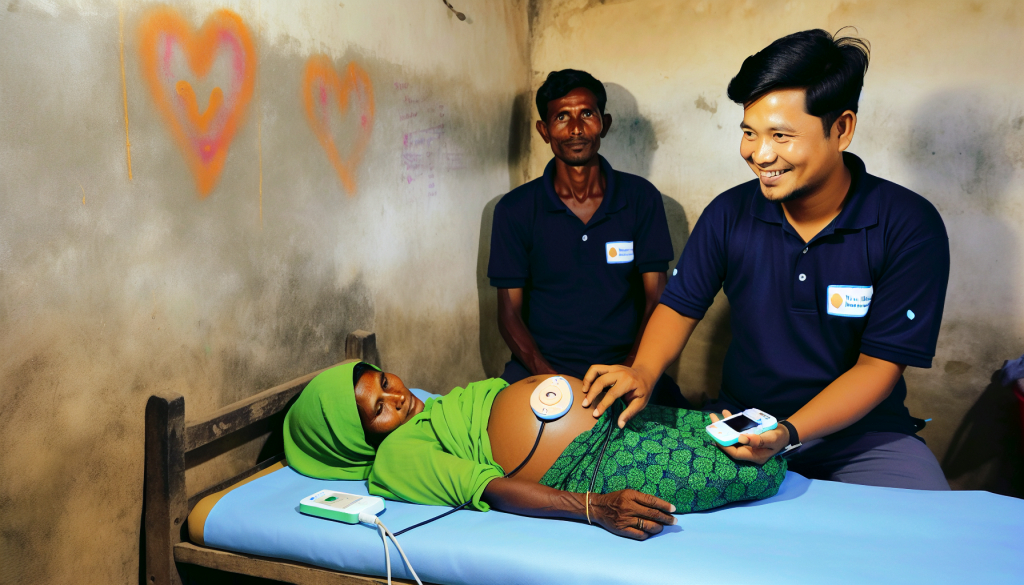
Image:
Dr. Beatrice Mwilike, the team leader in Tanzania, demonstrating the use of the iCTG device.
Credit: Melody International Ltd.
Nearly all newborn fatalities—about 99%—take place in low- and middle-income countries, where pregnant women often lack access to appropriate fetal monitoring tools. In Tanzania, where the neonatal death rate stands at 24 for every 1,000 live births, a new wireless fetal monitoring technology is showing encouraging outcomes in preventing infant health issues and reducing mortality.
A collaborative study led by researchers from Hiroshima University in Japan and Muhimbili University of Health and Allied Sciences in Tanzania has assessed the effectiveness of a mobile cardiotocography unit, known as iCTG. Conducted in four primary healthcare centers within Pwani region, the research findings were recently featured in BMC Public Health.
The device enhanced detection of irregular fetal heart rates by eight to tenfold and significantly lowered the rates of stillbirths and neonatal deaths by more than half.
“The addition of iCTG profoundly boosts detection of fetal health issues, improving outcomes even where resources are limited,” said Professor Yoko Shimpuku from Hiroshima University. “This is not a luxury but a vital, life-saving solution that can help prevent avoidable newborn setbacks.”
A wireless breakthrough
In Tanzania, premature birth and low oxygen levels during delivery are the leading causes of perinatal deaths. Existing monitoring equipment in these healthcare settings is often bulky, costly, or limited to simple tools like fetoscopes. These older methods rely on short manual checks and can miss serious warning signs.
The lightweight and wireless iCTG provides real-time alerts to healthcare staff when fetal heart rate irregularities are detected. This empowers them to act swiftly—by repositioning the mother, administering fluids or oxygen, or arranging for emergency transport. Even during transfers, the iCTG continues monitoring the fetal condition.
Between October 2023 and September 2024, the study followed 763 pregnant women in late pregnancy across four clinics in the Kisarawe and Bagamoyo districts. Of these, 492 were monitored using the iCTG device, while 271 received usual antenatal care without it.
Improved birth outcomes
The group that used the iCTG showed a marked decrease in perinatal deaths—dropping from 6.6% down to 2.6%. The device was far more effective in identifying fetal distress, detecting heart rate issues eight to ten times more often compared to traditional methods. There was also a noticeable drop in the number of babies born with low Apgar scores, which can signal breathing and general health problems.
There was, however, a rise in caesarean sections among the monitored group—recorded at 27.6% versus 10.3% in the standard care group. While surgical births can be life-saving when required, researchers stressed the importance of establishing clear guidelines to avoid unnecessary procedures.
Wider implementation and future directions
One challenge in LMICs is the low attendance rate at antenatal clinics (ANCs), often due to financial, educational or logistical barriers. Prior studies suggested that women with access to iCTG were more motivated to attend prenatal appointments. Interestingly, this study found slightly lower ANC attendance among women using iCTG, possibly because the intervention was introduced in later pregnancy stages. Researchers recommend introducing iCTG earlier in pregnancy to engage mothers and encourage consistent ANC visits through the opportunity to hear their baby’s heartbeat.
They also emphasized that effective fetal monitoring must be part of a broader package of quality maternal care for the full benefits to be realized. The team plans to expand the iCTG’s reach into more varied environments, while also assessing long-term benefits and cost efficiency. “Our goal is to integrate mobile CTG devices into everyday care across underserved regions, giving every expecting mother access to accurate, reliable fetal monitoring,” said Shimpuku.
###
Other key contributors to the study include Dorkasi L. Mwakawanga, affiliated with both Hiroshima University and Muhimbili University; Sanmei Chen, Md Moshiur Rahman, and Naoki Hirose from Hiroshima University; Crystal L. Patil of the University of Michigan; Beatrice Mwilike and Agnes F. Massae from Muhimbili University; and Yuryon Kobayashi from The University of Tokyo Hospital.
The research was supported by the Japan Agency for Medical Research and Development. The iCTG devices were created by Melody International Ltd. Hiroshima University covered the open-access publishing costs for the study.
About Hiroshima University
Established in 1949, Hiroshima University has evolved into one of Japan’s most esteemed institutions, offering comprehensive undergraduate and graduate education across 17 schools and faculties. Its interdisciplinary focus spans both the sciences and humanities, advancing scholarship and innovation at a global level.
Journal
BMC Public Health
DOI
10.1186/s12889-025-25383-4
Article Title
Effectiveness of a mobile cardiotocography device (iCTG) in improving antenatal care and detecting abnormal fetal heart rate during late pregnancy: an implementation study in Tanzania
Article Publication Date
26-Nov-2025