Researchers track microplastic particles in fertilizer from farmland to the coastline
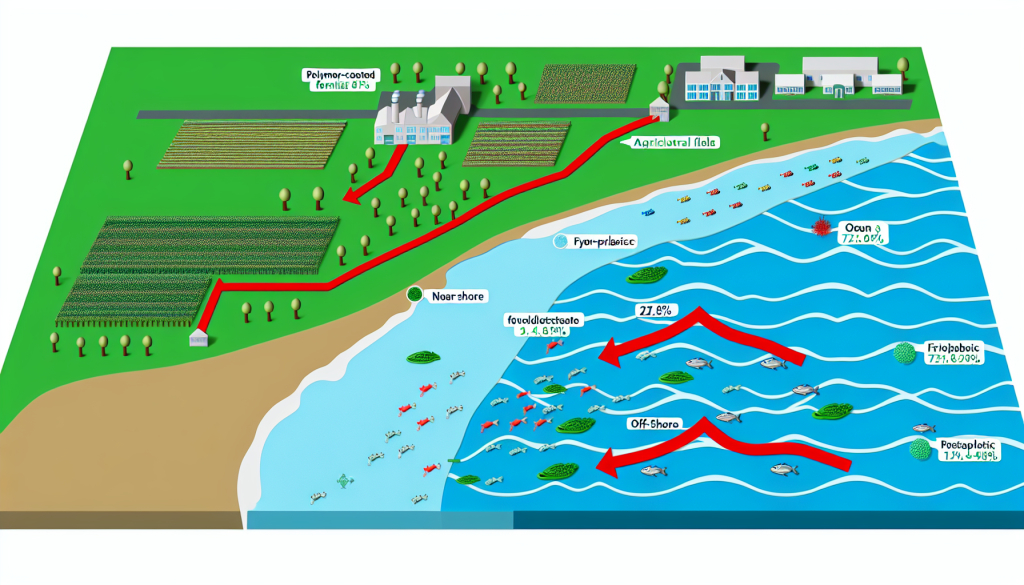
Image:
Distribution of microplastics from polymer-coated fertilizers. Of the total fertilizer capsules applied to rice paddies, approximately 77% remain in the fields, while just 0.2% make their way to beaches. Around 22.8% of the plastic is unaccounted for.
Source: Tokyo Metropolitan University
Tokyo, Japan – Scientists at Tokyo Metropolitan University have conducted a detailed investigation into how plastic from polymer-coated fertilizers (PCFs) ends up on coastlines and in marine environments. Their research examined PCF residues found on various Japanese beaches and shows that only a small fraction—0.2%—of the fertilizer capsules used in farming actually reach beaches via rivers. However, this figure rises dramatically to 28% in locations with direct water channels leading from farmland to the sea. These insights reveal a significant role these pathways play in microplastic pollution and point to a hidden portion of global plastic waste.
Oceanic plastic waste represents a growing concern for animal life, natural habitats, and public well-being. Research suggests that nearly 90% of the plastic that enters the oceans is no longer visible at the surface, instead settling on the ocean floor or being trapped in less obvious locations. To combat this issue, scientists are focusing on how plastic travels from where it is used to its final resting places in aquatic systems.
PCFs are a leading contributor to microplastic contamination. These fertilizers, wrapped in a thin plastic shell to gradually release nutrients, are common in Japanese and Chinese rice farming. They are also widely used in the cultivation of crops such as corn and wheat across Western nations including the United States and the United Kingdom. In Japan, studies have shown that between 50% and 90% of plastic debris found on beaches comes from PCFs. However, understanding how these particles move from land to the ocean remains limited.
The Tokyo-based research team, headed by Professor Masayuki Kawahigashi and Dr. Dolgormaa Munkhbat, surveyed PCF levels on beaches exposed to different environmental conditions. They focused particularly on areas near river mouths and on beaches close to direct outflows from crop fields, analyzing 147 sample locations on 17 separate coastlines. Their measurements showed that very little PCF—less than 0.2%—was found near river mouths, while a substantial 77% remained on farmland. The rest, around 22.8%, left the fields but did not make it back to beaches. However, in cases where direct drainage led from farmland to the ocean, up to 28% of fertilizers resurfaced on beaches. This suggests that wave motion and tides might return some of the microplastic to land, indicating that coastlines may temporarily trap such pollutants. Yet, the majority of plastic still vanishes, contributing to the unresolved issue of "missing" plastic.
The study also discovered that many PCF fragments collected from the beaches exhibited a reddish or brown color. Through analysis using Energy-Dispersive X-ray Spectroscopy (EDX), the team identified the presence of iron and aluminum oxide particles on the plastic’s surface. These chemical changes could be making the fertilizer capsules heavier, thereby reducing their likelihood of being returned to the shore by wave action. Though many questions remain about how PCFs move through the environment, this research marks an important early step in identifying how these materials contribute to the broader problem of disappearing plastic waste.
Journal
Marine Pollution Bulletin
DOI
10.1016/j.marpolbul.2025.119086
Article Title
A first approach to estimate the leakage of polymer-coated fertilizer-derived microplastics from paddy fields to beaches
Article Publication Date
5-Dec-2025