
DNA spring sensor gauges the force of cell motors
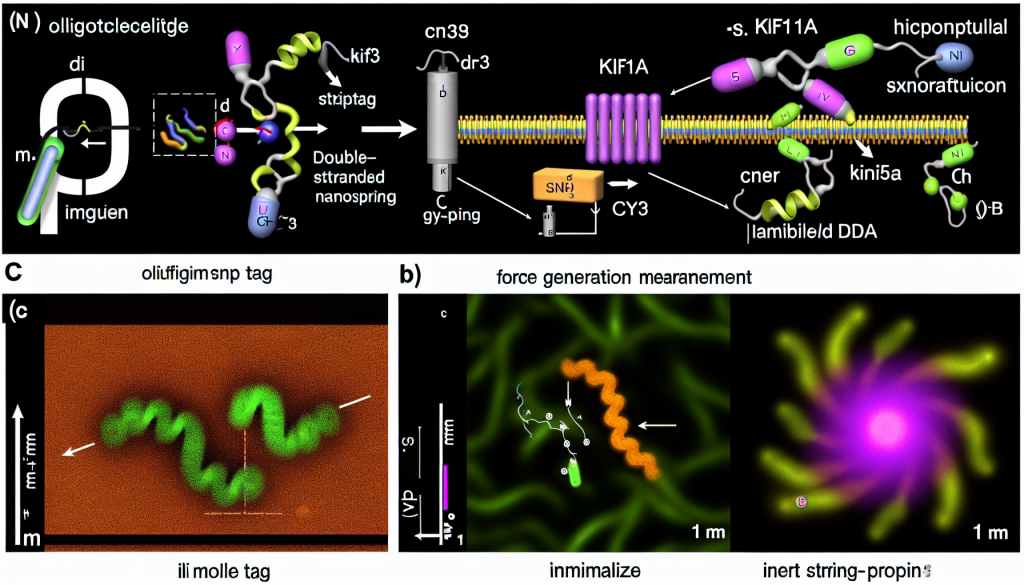
image:
A passive protein known as KIF5B acts as a stable point from which a nanospring made of DNA is pulled by the molecular motor KIF1A. Similar to regular springs, the more the nanospring stretches, the greater the force applied. In this case, fluorescent markers attached to the DNA spring reveal its extension, enabling researchers to visually track the strength generated by KIF1A's motion. ©2025 Hayashi et al. CC-BY-ND
Credit: ©2025 Hayashi et al. CC-BY-ND
Inside cells, especially nerve cells, moving materials is vital for their survival and functions. This task relies on proteins like KIF1A, which serve as molecular motors. However, mutations in KIF1A can lead to serious neurological issues, including motor difficulties, cognitive conditions, and neuron damage. Identifying these subtle impairments in KIF1A's function has been a challenge — until now. Scientists from institutions including the University of Tokyo and Japan’s National Institute of Information and Communications Technology (NICT) have developed a method using a DNA-based nanospring to detect the force KIF1A exerts, which may improve diagnoses related to protein malfunctions.
Neurological disorders like KIF1A-associated neurological disorder (KAND) significantly affect patients’ lives. This has led to extensive research efforts to mitigate symptoms. A crucial part of treatment is early diagnosis; understanding these diseases sooner offers a better chance at effective management.
"KAND results from defects in the KIF1A motor protein. Some defective forms can only produce motor force below 1 piconewton, while healthy versions reach about 3.8 piconewtons. These forces are minuscule — even the healthy form exerts just a trillionth of the force needed to lift a small object," explained Professor Kumiko Hayashi from the Institute for Solid State Physics at the University of Tokyo. "Earlier approaches used optical tweezers involving lasers, but they yielded weak signals and often failed. This led us to consider a DNA nanospring developed by Senior Researcher Mitsuhiro Iwaki from NICT — a first-of-its-kind innovation."
This nanospring is essentially a tiny coil made from DNA, mere nanometers in length — thousands of times thinner than a human hair. It can bind firmly to a solid surface and to KIF1A. Acting like a standard spring, it stretches in response to force. Its embedded fluorescent labels glow under a microscope, showing how much it elongates. This glow allowed Hayashi’s team to precisely measure the pulling force of KIF1A.
"We analyzed the fluorescent images of the nanospring and devised a method to calculate its length from those images," said Hayashi. "This process combined both biological techniques and computational analysis for single-molecule research."
The nanospring is crafted using a method known as DNA origami. This involves guiding a long DNA strand to fold into specific shapes by pairing it with many shorter sequences. With the help of software, researchers can create reliable 2D and 3D structures at the nanometer level. The nanospring benefits from this technology — its shape and mechanical properties are precisely defined thanks to predictable molecular interactions.
While the DNA nanospring itself isn't a treatment, its use in measuring KIF1A function offers an important step toward better diagnosis for conditions like KAND. Hayashi’s group now aims to develop large-scale data analysis tools, as researchers have identified over a hundred variations of the KIF1A gene. They hope to map out how each variant performs.
"By understanding how different mutations affect KIF1A’s mechanical behavior, we aim to build AI models that predict how severe a patient’s symptoms could become," added Hayashi.
###
Journal
eLife
DOI
10.7554/eLife.108477.1
Method of Research
Experimental study
Subject of Research
Cells
Article Title
Stall force measurement of the kinesin-3 motor KIF1A using a programmable DNA origami nanospring
Article Publication Date
7-Oct-2025