
Solar flares driven by magnetic surges
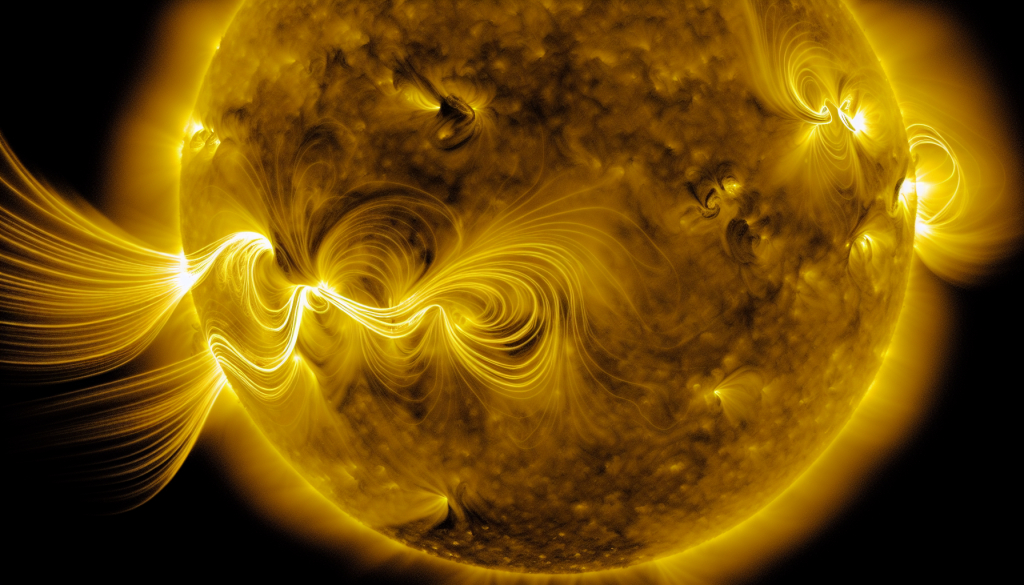
Image:
A still captured just before a powerful solar flare erupted on the Sun, shown in remarkable clarity by the Solar Orbiter spacecraft.
Credit: ESA & NASA/Solar Orbiter/EUI Team
Much like an avalanche begins with a minor shift in snow, the ESA-led Solar Orbiter has revealed that solar flares also originate from small-scale disruptions that escalate into more intense activity. This series of turbulent processes generates streams of plasma droplets that continue to fall even after the flare has ended.
This breakthrough came during Solar Orbiter’s close flyby of the Sun on 30 September 2024, providing one of the clearest observations of a major solar flare to date. The findings are detailed in a study set to be published in the journal Astronomy & Astrophysics on 21 January.
Solar flares are sudden, powerful bursts of energy from the Sun, emerging when built-up magnetic energy in tangled field lines is suddenly discharged through a process known as magnetic reconnection. This realignment of magnetic fields unleashes waves of high-temperature plasma and particles, pushing them outward. In extreme cases, such energy surges can ripple through space, affecting Earth's magnetic environment and potentially disrupting communication systems.
Despite their potential impact, the intricate mechanics behind such rapid energy releases have long puzzled scientists. Now, thanks to an ensemble of instruments aboard Solar Orbiter working in coordination, researchers have obtained the most comprehensive view yet of how these flares unfold.
Solar Orbiter’s high-tech camera, the Extreme Ultraviolet Imager (EUI), zoomed in on solar features only a few hundred kilometers across, capturing images every two seconds. Meanwhile, its other instruments – SPICE, STIX, and PHI – examined the Sun across layers of varying depths and temperatures, from the surface (photosphere) up to the corona. This allowed researchers to track flare formation over a critical 40-minute period.
“We were extremely fortunate to observe the initial stages of such a large flare with extraordinary clarity,” said Pradeep Chitta, a lead scientist at the Max Planck Institute for Solar System Research and main author of the study. “Gathering such high-frequency data isn't always practical due to on-board storage limitations, so we truly caught this event at the best possible moment.”
Unleashing the Magnetic Avalanche
At 23:06 UTC, EUI began documenting the area before the flare reached its peak. A dark, arching filament—a twisted ribbon of magnetic fields with plasma—was seen linked to a rapidly brightening cross-shaped magnetic structure.
With each frame, taken two seconds apart, new magnetic strands appeared. These strands twisted increasingly like coiled ropes.
Eventually, the system became unstable. The magnetic strands began breaking apart, initiating a cascade of reconnection events. This snowball effect led to progressively brighter flash points in the images, signaling mounting energy release.
At 23:29 UTC, a distinct brightening happened as the dark filament tore free and launched into space, unraveling at high velocity. Incredibly detailed imagery showed luminous points of reconnection fire along the filament as the main flare exploded at approximately 23:47 UTC.
“These moments before the flare are key,” said Chitta. “Solar Orbiter let us peer into the very core of the process driving the flare—an avalanche-like chain reaction of small magnetic changes.”
Previously, this type of avalanche model had been theoretically proposed to explain widespread flare activity, but it wasn’t clear if it applied to a single, large event. This observation confirms that even a major flare consists of a quick succession of interlinking magnetic disruptions.
Streams of Falling Plasma
Thanks to observations from SPICE and STIX, the researchers were able to examine in great detail how this rapid-fire series of magnetic reconnections impacted the Sun’s outermost layers.
High-energy X-ray readings showed where particles, accelerated by the flare, poured their energy into the solar atmosphere. Since these fast-moving particles can travel through space and affect satellites and astronauts, studying this process is vital for space weather prediction.
During the 30 September event, ultraviolet and X-ray emissions were already increasing when SPICE and STIX first trained their sights on the region. As the flare escalated, so did these emissions, with particles reaching speeds up to 50% the speed of light—about 540 million km/h. The data clearly showed that magnetic energy was being converted into plasma motion and heating.
“We saw fast-moving, ribbon-like patterns descending through the solar atmosphere before the main flare had even begun,” Chitta explained. “These ‘plasma rain’ formations are clear signs of energy being deposited. They intensified during the flare and continued even after the main activity died down. It’s the first time we’ve observed such detail in both space and time.”
Post-flare, the magnetic cross formation visibly settled according to EUI images. Meanwhile, cooling of the plasma and declining particle emissions were recorded by SPICE and STIX. Completing the event’s 3D profile, PHI captured how the flare left marks detectable on the Sun’s surface.
“We didn’t anticipate that this cascading avalanche effect could produce such high-energy outcomes,” Chitta noted. “We still have much to learn, and future missions with even sharper X-ray imaging will help uncover more.”
Miho Janvier, ESA’s Solar Orbiter Co-Project Scientist, added, “This is one of Solar Orbiter’s most thrilling discoveries so far. It provides a critical glimpse into the trigger mechanism of flares and how these interlinked events play out. It raises the question: do all solar flares work this way—and what about those seen on other stars?”
“These close-up, time-lapsed observations gave us a chance to see how minor events can group together into a massive energy surge,” said David Pontin from the University of Newcastle, a co-author of the paper.
He continued, “By aligning these images with magnetic field data, we successfully traced the full sequence leading to the flare. This challenges traditional flare theories and presents an opportunity to refine them going forward.”
Journal
Astronomy and Astrophysics
DOI
10.1051/0004-6361/202557253
Method of Research
Observational study
Subject of Research
Not applicable
Article Title
A magnetic avalanche as the central engine powering a solar flare
Article Publication Date
21-Jan-2026
Solar Orbiter is a collaborative mission between ESA and NASA, operated by ESA. Various scientific instruments on board are led and managed by institutions across Europe, including Belgium, Germany, France, and Switzerland.
Media Contact: ESA Media Relations – [email protected]