
Iowa-based research team identifies and details new crocodile that preyed on iconic Lucy’s species
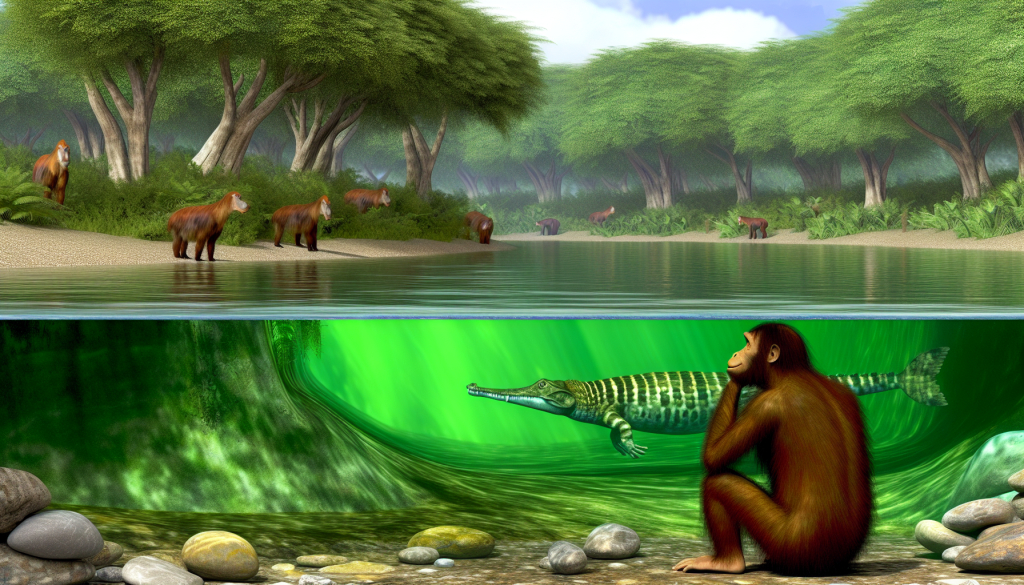
image:
A team of scientists led by the University of Iowa has identified and named a previously unknown crocodile species that lived in Africa more than 3 million years ago. The species has been nicknamed Lucy’s hunter because it shared both time and territory with the famous hominin Lucy and likely preyed upon her kind.
Credit: Tyler Stone, University of Iowa.
Over 3 million years ago, when early human ancestors such as the well-known Lucy moved across the African landscape, they likely faced a formidable predator. Concealed in rivers and lakes, a massive crocodile bearing a distinctive bump on its snout would have waited patiently to ambush animals that approached the water’s edge.
Researchers have now determined that this reptile represents a new species. In a study published on March 12 in the Journal of Systematic Palaeontology, the team formally describes the animal and names it Crocodylus lucivenator, meaning “Lucy’s hunter.”
The name reflects the species’ place in history. The crocodile lived between 3.4 million and 3 million years ago in what is now Ethiopia, overlapping with Lucy’s species, Australopithecus afarensis. Discovered in 1974, Lucy’s remarkably complete skeleton transformed our understanding of human evolution, showing that upright walking evolved before larger brain size.
This newly identified crocodile measured between 12 and 15 feet long and weighed an estimated 600 to 1,300 pounds. As the only crocodile species known from the Hadar area during that period, it dominated a landscape of shrublands and wetlands crisscrossed by tree-lined rivers. The researchers describe it as an ambush predator, lying submerged and motionless before striking animals that came to drink.
“It was the top predator in its ecosystem, even more imposing than lions or hyenas, and it would have posed a serious threat to early hominins,” says Christopher Brochu, professor in the Department of Earth and Environmental Sciences at Iowa and the study’s corresponding author. “It’s very likely that this crocodile hunted Lucy’s species. We can’t know whether Lucy herself encountered one, but her kind would certainly have been on its menu.”
Brochu has studied fossil crocodiles for more than three decades. He first examined the Crocodylus lucivenator material during a 2016 visit to a museum in Addis Ababa, Ethiopia.
“What stood out immediately was its unusual mix of features,” Brochu says.
One of the most striking traits was a pronounced hump centered on the snout. While similar structures appear in American crocodiles, they are absent in Nile crocodiles. The researchers suggest that males may have used this raised feature in courtship displays.
“In some living crocodiles, males tilt their heads to highlight certain features to females,” Brochu explains. “This hump may have served a similar purpose.”
The species also possessed a snout that extended farther beyond the nostrils than those of other crocodiles from the same era, resembling the elongated snouts seen in many modern species.
The team analyzed 121 fossil specimens, including skulls, teeth, and jaw fragments, representing dozens of individuals. These remains were excavated from the Hadar Formation in Ethiopia’s Afar region, an area renowned for discoveries related to early human evolution and recognized as a UNESCO World Heritage site.
Although many fossils were incomplete and required reconstruction, one jaw specimen displayed partially healed bite wounds, indicating that the animal had survived a violent encounter with another crocodile. Stephanie Drumheller, a study co-author and teaching associate professor at the University of Tennessee who earned her doctorate at Iowa, notes that such injuries are consistent with behavior seen in modern crocodiles.
“Face-biting and combat injuries appear throughout the crocodile family tree,” Drumheller says. “We don’t know which animal won that particular fight, but the healing shows this individual survived the clash.”
While at least three other crocodile species lived farther south in the Eastern Rift Valley, evidence suggests that Lucy’s hunter was the sole crocodile species inhabiting the Hadar region at that time.
“During the Pliocene, Hadar included a mosaic of environments—woodlands, forests, wetlands, grasslands, and shrublands—shifting over time around lake and river systems,” says Christopher Campisano of Arizona State University, a study co-author. “Notably, this crocodile was one of the few species that persisted across these changing habitats.”
The study is titled “Lucy's Peril: A Pliocene Crocodile from the Hadar Formation, Northeastern Ethiopia.”
Nathan Platt and Daniel Leaphart from the School of Earth, Environment, and Sustainability at Iowa contributed to the research. Additional co-authors include Getahun Tekle and Tomas Getachew of the National Museum of Ethiopia, and Jason Head of the University of Cambridge.
The research was supported by the U.S. National Science Foundation, the Leakey Foundation, the University of Iowa Office of International Programs, and the College of Liberal Arts and Sciences at Iowa.
Journal
Journal of Systematic Palaeontology
Method of Research
Systematic review
Subject of Research
Animals
Article Title
Lucy's Peril: A Pliocene Crocodile from the Hadar Formation, Northeastern Ethiopia
Article Publication Date
12-Mar-2026
COI Statement
The authors declare no conflicts of interest.