
Revealing Advanced Maturity and Rapid Aging in the Hippocampus
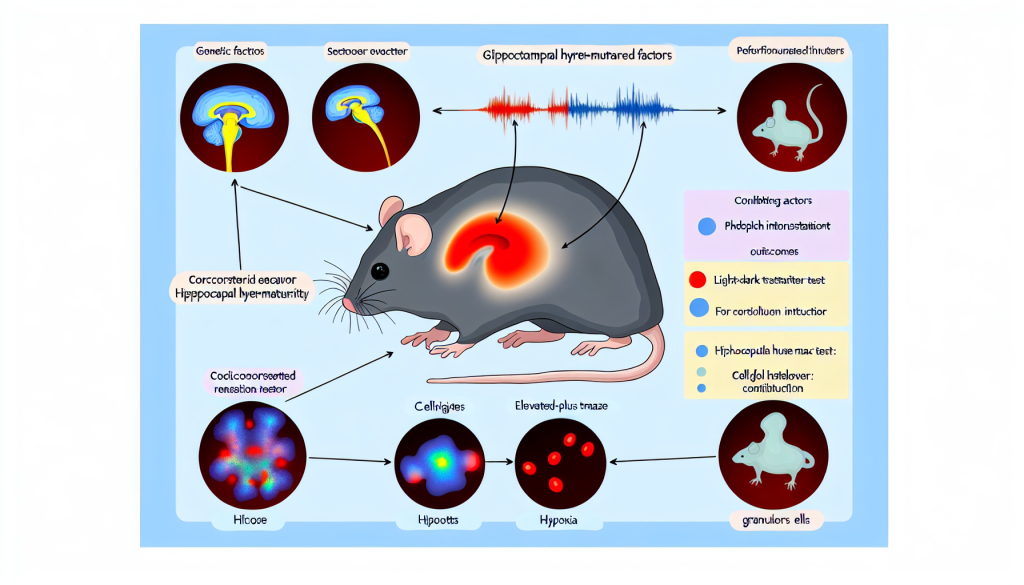
image:
Advanced hippocampal development and aging linked to anxiety behavior
Credit: Dr. Hideo Hagihara, Fujita Health University, Japan
Toyoake, Japan — October 27, 2025 — A pioneering study by scientists from Fujita Health University and the Tokyo Metropolitan Institute of Medical Science has uncovered a new type of brain abnormality associated with anxiety—excessive neural development and aging in the hippocampus. This condition, called "hyper-maturity," was identified through an extensive gene expression analysis in 17 data sets across 16 different mouse models with neuropsychiatric traits such as anxiety, depression, schizophrenia, and neurodegenerative disorders. Published in the journal Neuropsychopharmacology, the findings highlight a previously overlooked pattern of brain changes in mental health research.
"Our earlier work mostly explored immature neuronal development in brain disorders, but in this study, we found the opposite—some mouse models display advanced gene activity, signifying accelerated development and aging," explained Dr. Tsuyoshi Miyakawa, the study’s senior author.
Synaptic Gene Activity Connected to Hyper-Maturity and Anxiety
The research team discovered that 16 mouse models showed gene patterns signifying rapid postnatal growth of the hippocampus, marking them as hyper-maturity models. These gene groups were notably rich in pathways involving synaptic function. Important genes such as Camk2a and Grin2b were repeatedly elevated, indicating enhanced synaptic activity.
The hippocampus—a brain area vital for emotion and memory—exhibits lifelong adaptability. To measure developmental progress in this region, the scientists devised a “maturity index” from gene expression data. Their results showed a clear trend: more advanced hippocampal maturity correlated with heightened anxiety-like behaviors in mice. Conversely, models previously linked to immature hippocampal development tended to show lower levels of anxiety. Mice exposed to chronic stress hormones like corticosterone mirrored these findings, with both hyper-mature hippocampal profiles and elevated anxiety symptoms, suggesting that stress may contribute to these neurobiological changes.
The results point to disrupted hippocampal development—whether under or overdeveloped—as a possible factor influencing emotional health, likely through altered synaptic gene activity. However, the direct cause-and-effect link between these brain changes and anxiety still needs to be fully established.
Premature Onset of Aging
Since postnatal growth and aging form a continuous biological timeline, the researchers compared hyper-maturity gene profiles with those typically seen in both youth and aged brains. They found that some models matched early-life development patterns, while others resembled aged brains more closely:
• Models such as serotonin transporter (Sert) knockouts and age-prone SAMP8 mice reflected enhanced postnatal development.
• Models like corticosterone-exposed mice and those with lysosomal storage conditions aligned more closely with accelerated aging profiles.
Targeted analysis of brain cell types suggested that changes in microglia, astrocytes, and granule cells could be part of the aging-related gene expression observed in these models.
Potential Human Impact
To explore if these findings applied to humans, researchers looked at gene expression in the hippocampus from donated brains of individuals diagnosed with depression, bipolar disorder, and schizophrenia. There were overlapping patterns with the mouse hyper-maturity models, although the degree varied due to the complexity of human psychiatric conditions. These patterns support earlier claims that psychological stress can speed up the biological aging of the brain.
"This suggests that excessive hippocampal development may represent a shared biological feature across different mental health disorders," said Dr. Hideo Hagihara, the study’s lead author. "Some of the genes involved could even lead to cross-diagnostic biomarkers or new treatment possibilities."
Moving Toward New Understanding and Therapies
"We still don’t have a full grasp of why various genetic and environmental factors result in hyper-mature brain profiles," said Dr. Miyakawa. "Brain development and aging aren’t fixed processes; they adapt over time under influences such as neuronal activity, stress, and inflammation. If we can learn how to adjust these patterns, we might eventually discover ways to renew brain functions—opening new avenues in psychiatric care and aging research."
This investigation not only enhances our understanding of mental illnesses but also shifts the way we study aging in the brain—pointing to maturation pathways in non-dividing neurons as a key focal area beyond the well-known decline seen in neurodegeneration or reduced neurogenesis.
***
Reference
DOI: 10.1038/s41386-025-02237-6
About Fujita Health University
Fujita Health University (FHU), located in Aichi, Japan, is a prominent private medical institution founded in 1964. It operates one of the country’s largest university hospitals and is staffed by around 900 faculty members who provide diverse training to students from across the globe. Guided by its mission of "Our creativity for the people," FHU empowers students to lead through innovation. The university is globally recognized, having ranked eighth overall and second among private Japanese institutions in the 2020 Times Higher Education World University Rankings. In the 2024 University Impact Rankings, FHU ranked fourth worldwide for its efforts in promoting Good Health and Well-being, a key goal set by the United Nations. In June 2021, FHU became the first Japanese university to host the Asia Universities Summit. In 2024, it was selected for the J-PEAKS Program by the Japanese government to help create a research-driven, collaborative ecosystem for academic drug discovery.
Journal
Neuropsychopharmacology
DOI
10.1038/s41386-025-02237-6
Method of Research
Experimental study
Subject of Research
Animals
Article Title
Hyper-maturity and accelerated aging in the hippocampus of mouse models of neuropsychiatric disorders with anxiety-like behavior
Article Publication Date
27-Oct-2025
COI Statement
The authors report no conflicts of interest.