Numbers in focus shape our sense of space
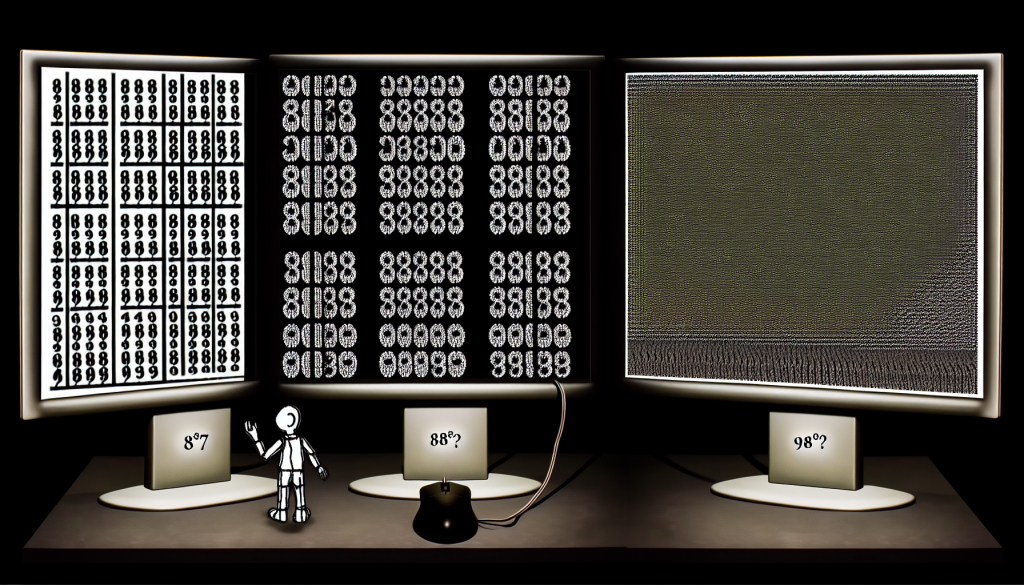
Bisection exercises highlight how numbers can influence our spatial judgment. When numbers are included within shapes, they subtly alter how participants perceive the center point.
Credit: Tokyo Metropolitan University
Tokyo, Japan – A team at Tokyo Metropolitan University has explored how numerical elements in visual stimuli impact spatial perception. In their study, participants were asked to locate the center of lines and squares that contained numbers. The deviation from the true center indicated unexpected distortions in perception. Notably, their square-based tasks demonstrated that how we perceive space involves more than just number recognition—it also shows how we interpret objects as a whole.
We often don't realize how numbers influence our spatial awareness. This connection, known as spatial-numerical association, can lead to what are called attentional biases. For instance, in cultures where reading is left to right, people tend to respond faster when a smaller number appears on the left side of a screen, and similarly, larger numbers prompt quicker reactions when placed on the right. Interestingly, it’s not limited to numbers—even cues like brightness or volume can trigger similar responses. These patterns appear not only in people but also in animals and insects, suggesting a deep-rooted mental system that maps magnitude across space. By better understanding these tendencies, scientists can improve both our comprehension of brain function and the way information is organized and displayed in our environments.
Under the guidance of Professor Masami Ishihara and PhD student Ryo Hishiya, the researchers turned to bisection tasks to investigate these biases. In these tests, participants indicated where they believed the center of a line to be. It was found that when smaller numbers filled the bar, subjects marked the midpoint more to the left than they did for lines with larger numbers, confirming the idea of a left-to-right mental number layout. However, when the same method was applied vertically, participants surprisingly selected lower points for larger numbers, defying previous beliefs about vertical number positioning. This implied that different mechanisms might interact in complex ways.
To take things further, the researchers employed two-dimensional shapes—squares—in their trials. Interestingly, numerical value no longer influenced perception in the same way. Instead, simply having numbers present caused a noticeable upward bias and a slight leftward bias. When no numbers were included, subjects showed a stronger leftward tendency, which may be explained by an automatic attention shift to the left known as pseudoneglect. The team believes that the upward drift is due to the brain’s ventral visual stream, a region associated with object recognition. In this setting, the object-like quality of numbers appears to override their value, indicating that how we interpret visual objects dominates how we process numerical data.
Although many questions remain, these findings offer new insights into how minor factors shape our visual understanding of space.
Journal
Scientific Reports
DOI
10.1038/s41598-025-21167-3
Article Title
Numerically induced attentional biases in horizontal, vertical, and two-dimensional shapes
Article Publication Date
21-Oct-2025