
Field expeditions and museum archives uncover concealed pit viper diversity across High Asia
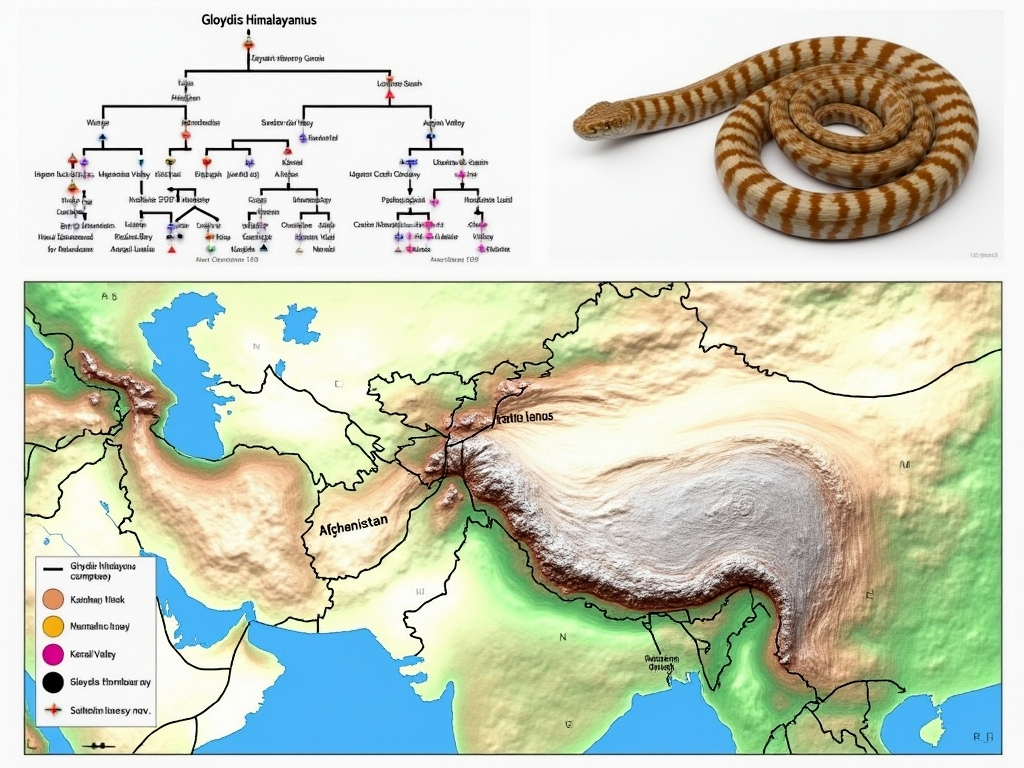
image:
Phylogenetic relationships and geographic range of five pit viper species across the Himalaya and Hindu Kush.
Credit: Dr Daniel Jablonski
The towering mountain systems of Asia are still among the least thoroughly studied biological regions on the continent. An international team of scientists has now revealed that one of their most secretive venomous snakes, long classified as a single species, actually represents a complex of five separate species, three of them previously unknown to science.
The research, published in the open-access journal ZooKeys, re-examines the Himalayan pit viper group through an integrative approach that combines newly collected and historical DNA, external morphology, skeletal characteristics, and ecological data. The findings show that what had traditionally been regarded as a single, widespread species—first described in 1864—actually comprises several deeply divergent evolutionary lineages.
The team identified five clearly distinct species-level lineages: the Himalayan pit viper in the strict taxonomic sense, Gloydius chambensis described in 2022, and three newly recognized species from different regions of Pakistan and Nepal. In addition to strong genetic differences, each lineage displays unique morphological and skeletal traits.
"These mountain regions continue to conceal overlooked vertebrate diversity and provide crucial insights into Asia’s biogeographic history," says Daniel Jablonski of Comenius University Bratislava, who has conducted extensive fieldwork in Pakistan and Afghanistan over many years.
"By merging modern field sampling with information from historical museum material, we were able to uncover evolutionary lineages that had remained undetected for more than a century after the Himalayan pit viper was first described."
- Daniel Jablonski
A central component of the study was the integration of recently collected specimens with DNA obtained from museum material gathered in the late 19th and early 20th centuries. This included the original type specimen of the Himalayan pit viper, enabling the researchers to clarify the precise scientific identity of the species.
The study highlights the lasting importance of natural history collections. Specimens collected by earlier explorers and preserved in museums continue to provide essential data for solving present-day scientific questions, particularly in remote areas where field research remains challenging.
In some cases, the evidence had been available for decades. "Museum collections are not merely archives of the past. They are dynamic research resources and fundamental infrastructure for future discoveries," explains Sylvia Hofmann from the Museum Koenig at the Leibniz Institute for the Analysis of Biodiversity Change, who has worked extensively in the Himalaya and on the Tibetan Plateau for over 20 years.
"Some of the decisive material had been preserved in collections for more than a hundred years. We simply lacked the analytical tools to interpret it properly. As methods continue to advance, the scientific relevance of these collections will only increase, revealing biodiversity that was previously unrecognized."
- Sylvia Hofmann
Herpetofauna play a vital ecological role, functioning as indicators of environmental health, integral components of food webs, and predators that help regulate pest populations. In the Himalayan region, pit vipers represent a group of top predators adapted to harsh mountain conditions, yet they have historically received limited scientific attention.
"Our research seeks to reduce these knowledge gaps and to establish a foundation for more detailed investigations into this ecologically and medically significant group."
- Frank Tillack of the Museum für Naturkunde Berlin, Leibniz Institute for Evolution and Biodiversity Research
Tillack has maintained long-standing collaborations with colleagues in Nepal and has worked with them for 35 years on projects exploring Himalayan herpetofaunal diversity.
The findings also demonstrate how much remains to be discovered in regions that have been difficult to access due to geographical and socio-political challenges. “The high mountain landscapes of Pakistan continue to yield remarkable biological discoveries,” says Rafaqat Masroor of the Pakistan Museum of Natural History, one of the country’s leading herpetologists.
"This discovery underlines how limited our understanding remains in a region shaped by prolonged socio-political instability."
- Rafaqat Masroor
Beyond refining taxonomy, the study carries important conservation implications:
"Each of the newly identified species appears to have a relatively restricted distribution within fragile mountain habitats, raising new ecological and evolutionary questions."
- Daniel Jablonski
Without formally recognizing this hidden diversity, it would be impossible to evaluate its conservation status accurately or implement effective protection strategies.
Journal
ZooKeys
DOI
10.3897/zookeys.1280.182768
Subject of Research
Animals
Article Title
Integrative taxonomy reveals previously undescribed diversity within the Gloydius himalayanus complex (Squamata, Viperidae, Crotalinae) from the Himalaya and Hindu Kush
Article Publication Date
21-May-2026